 Mayaprotocol
 liquidity nodes: when bonding fits
Maya Protocol’s liquidity nodes secure MAYAChain with bonded liquidity-provider (LP) units. This model fits operators who can maintain validator infrastructure and accept restricted withdrawals and slashing exposure. Eligible active nodes can receive node-exclusive rewards alongside liquidity rewards, while their bonded capital remains in trading pools.
- last updated
Match participation to the job
| Goal | Position or status | Relevant outcome | Main constraint |
|---|---|---|---|
| Earn from trading liquidity without running servers | Unbonded LP position | A proportional share of the pool’s allocated liquidity rewards | Pool asset exposure remains, and the network’s incentive allocation can reduce rewards. There’s no node-exclusive allocation. |
| Provide validator services using pooled capital | Active liquidity node | Eligibility for node-exclusive rewards as well as liquidity rewards | Infrastructure duties, penalties and restrictions on unbonding apply. |
| Compete for validator admission while capital stays pooled | Liquidity bonded to a standby node | Eligibility for liquidity rewards while awaiting selection | Standby status doesn’t establish active-node income. Churn-in selection favors qualifying candidates with larger bonds. |
How the bond and reward streams relate
LP units represent ownership in liquidity pools that pair CACAO with a connected asset. Bonding LP units from an eligible pool makes the position collateral for a node while the underlying assets continue to support swaps. The position therefore retains exposure to both assets in its pool.
- Liquidity rewards (LR)
- These follow the participant’s share of pool liquidity. Both bonded and unbonded liquidity participate in this reward category, subject to the network’s allocation.
- Node-exclusive rewards (NER)
- The liquidity-node model divides each block’s node-exclusive allocation evenly among eligible active nodes. Increasing a node’s pool share doesn’t, by itself, increase its fraction of the node-exclusive allocation.
The Incentive Pendulum changes the allocation between bonded and unbonded liquidity according to the network’s security needs. The Liquidity Nodes guide describes an under-bonded state in which unbonded liquidity receives no reward allocation. Pool participation therefore doesn’t establish a fixed positive yield, and the model’s examples don’t establish the network’s active parameter values.
Operator work and other ways to supply capital
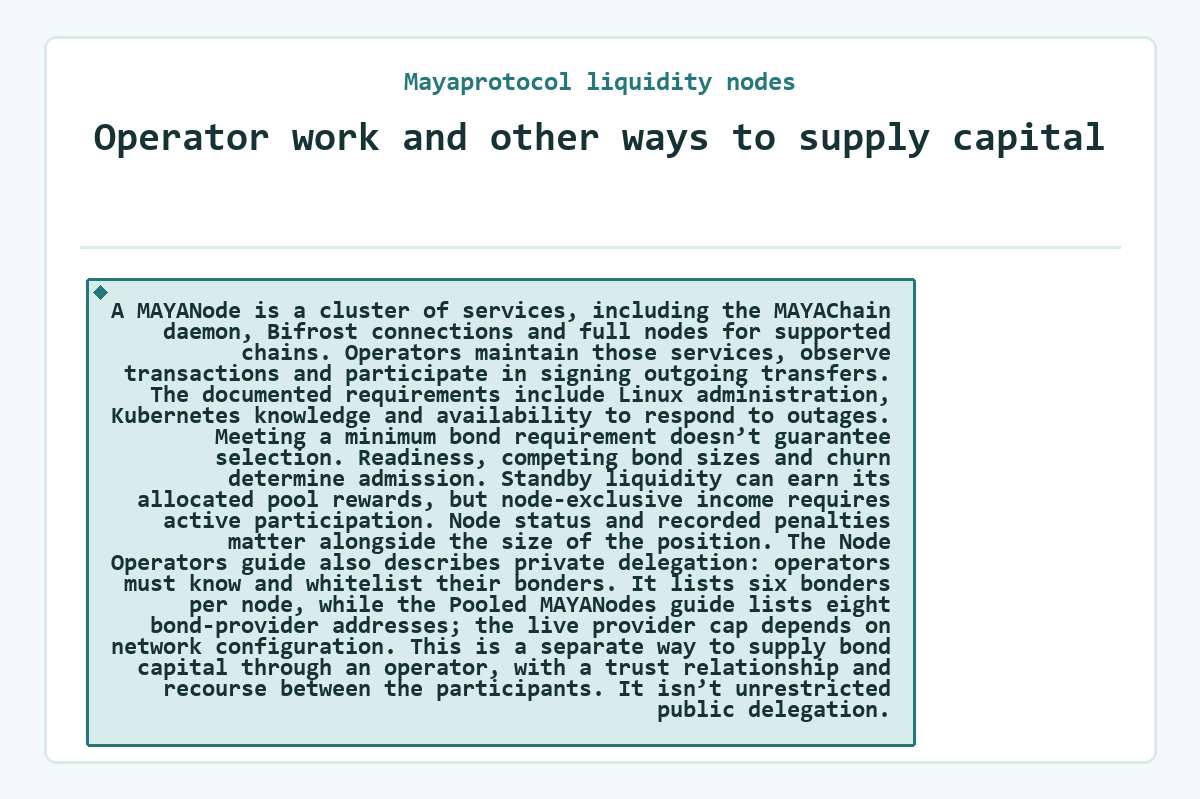
A MAYANode is a cluster of services, including the MAYAChain daemon, Bifrost connections and full nodes for supported chains. Operators maintain those services, observe transactions and participate in signing outgoing transfers. The documented requirements include Linux administration, Kubernetes knowledge and availability to respond to outages.
Meeting a minimum bond requirement doesn’t guarantee selection. Readiness, competing bond sizes and churn determine admission. Standby liquidity can earn its allocated pool rewards, but node-exclusive income requires active participation. Node status and recorded penalties matter alongside the size of the position.
The Node Operators guide also describes private delegation: operators must know and whitelist their bonders. It lists six bonders per node, while the Pooled MAYANodes guide lists eight bond-provider addresses; the live provider cap depends on network configuration. This is a separate way to supply bond capital through an operator, with a trust relationship and recourse between the participants. It isn’t unrestricted public delegation.
Does doubling the pool share double both rewards?
Compare two hypothetical self-funded active nodes with different ownership shares in the same pool. For one hypothetical reward period, hold these inputs fixed: the pool’s liquidity-reward allocation is 842 CACAO, the network’s node-exclusive allocation is 3182 CACAO and the same 37 eligible nodes remain active throughout the period. The hypothetical pool shares are 2% and 4%. All amounts below are reward-accounting allocations before operating expenses, penalties or service-fee arrangements.
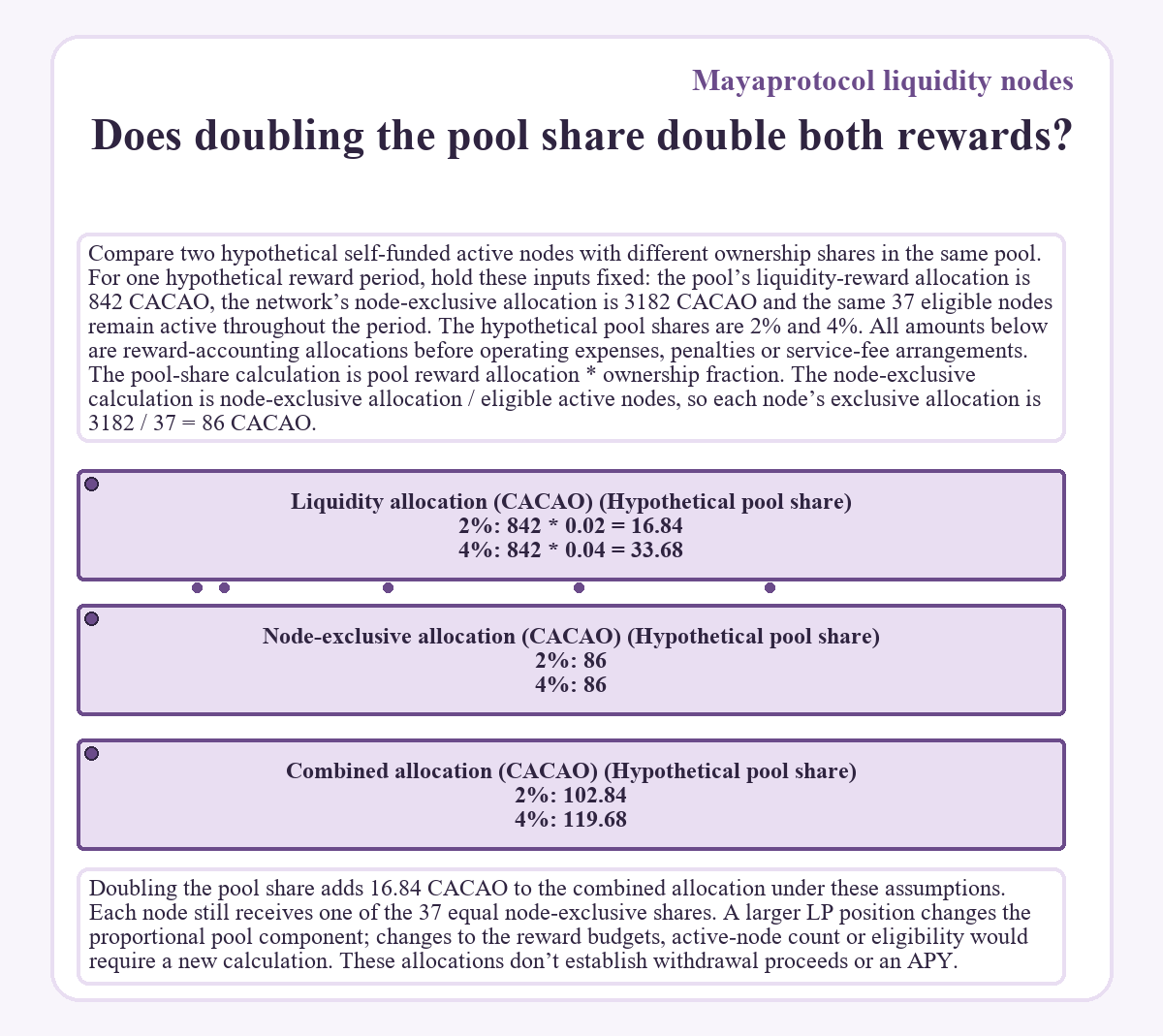
The pool-share calculation is
pool reward allocation * ownership fraction
. The node-exclusive calculation is
node-exclusive allocation / eligible active nodes
, so each node’s exclusive allocation is
3182 / 37 = 86
CACAO.
| Hypothetical pool share | Liquidity allocation (CACAO) | Node-exclusive allocation (CACAO) | Combined allocation (CACAO) |
|---|---|---|---|
| 2% | 842 * 0.02 = 16.84 | 86 | 102.84 |
| 4% | 842 * 0.04 = 33.68 | 86 | 119.68 |
Doubling the pool share adds 16.84 CACAO to the combined allocation under these assumptions. Each node still receives one of the 37 equal node-exclusive shares. A larger LP position changes the proportional pool component; changes to the reward budgets, active-node count or eligibility would require a new calculation. These allocations don’t establish withdrawal proceeds or an APY.
Pool losses and node penalties affect different things
Pool assets have floating market prices. Their relative prices change the asset mix that an LP owns, and fees and rewards may fail to offset impermanent loss. A liquidity position doesn’t promise the same quantity of deposited assets back.
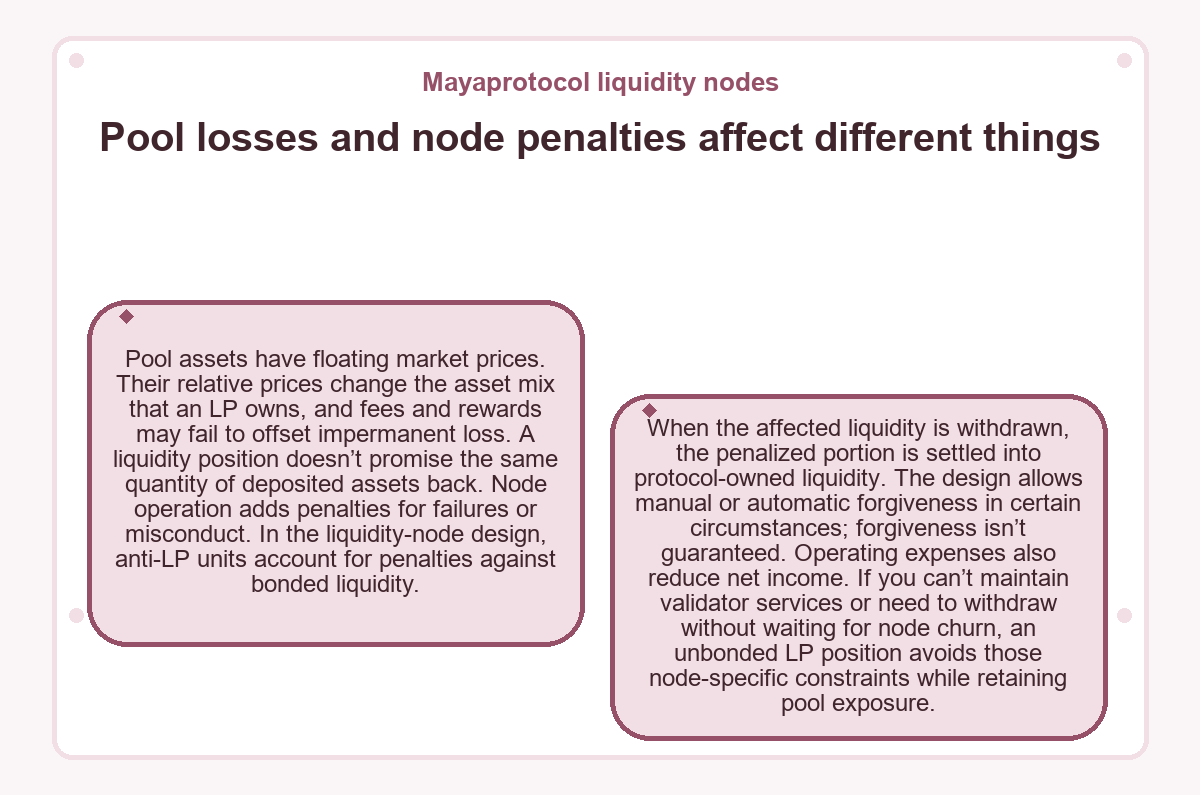
Node operation adds penalties for failures or misconduct. In the liquidity-node design, anti-LP units account for penalties against bonded liquidity. When the affected liquidity is withdrawn, the penalized portion is settled into protocol-owned liquidity. The design allows manual or automatic forgiveness in certain circumstances; forgiveness isn’t guaranteed.
Operating expenses also reduce net income. If you can’t maintain validator services or need to withdraw without waiting for node churn, an unbonded LP position avoids those node-specific constraints while retaining pool exposure.
Withdrawal depends on node status
- Unbonded pool liquidity
- The liquidity-provider guide allows withdrawal by the original depositor’s address, subject to confirmation time and withdrawal fees. The return is the position’s share of the pool’s final balances and earnings.
- Standby node
- A standby operator can request unbonding without using the permanent LEAVE process or waiting for a regular churn. This applies to standby status; a ready node can’t unbond.
- Ready or active node
- Both statuses restrict unbonding. An active operator can wait for normal churn-out and then request unbonding in standby. LEAVE requests a permanent exit that disables the node address once completed. The MAYANode Overview describes accrued node rewards as claimed when the node leaves. Pending penalties against LP units are settled when the affected liquidity is withdrawn.
Leaving validator service and withdrawing pool assets are separate actions. A leave request alone doesn’t make active bonded liquidity available for withdrawal.